The Shock Election
Published October 10, 2019
Wrriten by Reuben X. Wang
Singapore's 1955 elections heralded in a new age of political possibilities. It also closed the door on conservative approaches to government.
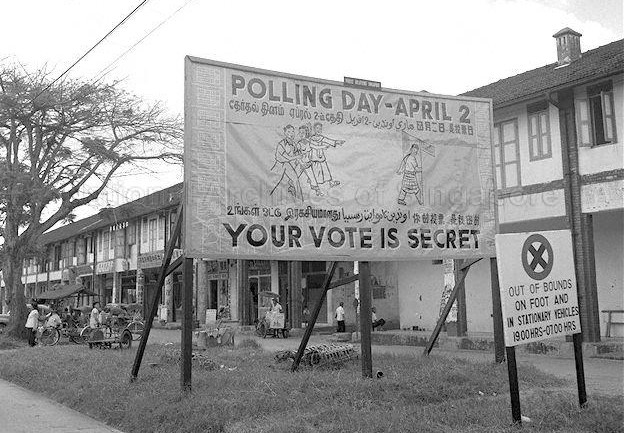
The Legislative Assembly Elections of 1955 were Singapore's first elections to feature universal suffrage. Voter turnout was high. The election was closely fought by charismatic and spirited candidates representing a dazzling diversity of political positions and ideologies.
1955 was the first foray into electoral politics for many of the political titans which will shape Singaporean politics and lead Singapore's fight for independence. Amongst them, David Marshall, Lim Chin Siong, and Lee Kuan Yew.
Labour wins by being first past the post
Right wing parties won over 50% of the popular vote; they argued for a slow, measured approach to the question of independence.
But the two major right-wing parties, the Democrat and Progressive Parties, split the vote between them.
This allowed the parties of the Left Wing to win big.
Mouse over the graph to find out how many votes each party won.
Here are how the results look by constituency. The winners are highlighted in a yellow outline.
13 out of the 25 seats were won with less than 50% of the vote.
These charts are sorted, in descending order, by the popular vote of the winning party. You can identify the "minority winners" as the last 13 charts in this collection.
A Singapore of a different age
Singapore was a really different place in 1955.
893,600 people lived in today's downtown core. The mass majority of Singapore's population lived in today's Central Planning District, bounded roughly from between Tanjong Pagar, Novena, and Queenstown.
Singapore's city was marked by social and economic contrasts. Dockworkers in Tanjong Pagar lived in slums with a population density of over 2 persons per metre square. A few streets away were bungalows.
Off the West Coast, 11,700 people still lived in the Southern Islands - even though there already was, in 1955, a Royal Dutch Shell oil depot on Bukom Island.
Even Singapore's landscape was different. Changi airport has not yet been reclaimed. Singapore still had a rural countryside, where 19.3% of the population resided. The 100-metre hills that dominated Tampines and Bedok had yet to be levelled to provide landfill material in Singapore's East Coast.
Drag the divider between the two map to compare Singapore in 1955 and Singapore in 2019.
To protect the interest of rural residents, the Electoral Commission divided Singapore into 3 types of electoral divisions.
Urban voters were disadvantaged. Urban electoral divisions had, on average, twice as many eligible voters than rural electoral divisions. As a result, their votes were diluted.
| Constituency Type | Total Voters | Voters per Constituency | No. of Constituencies |
|---|---|---|---|
| Urban | 669,599 | 55,800 | 12 |
| Mixed | 187,700 | 37,400 | 5 |
| Rural | 257,500 | 32,200 | 8 |
|
Urban Zone |
|
|
Mixed Zone |
|
|
Rural Zone |
The Urban Working Class
The New Kingmakers
The boundaries of the urban zone were derived from the legal jurisdiction of the City of Singapore. The city's population was predominantly working class.
In urban electoral divisions, Left-wing parties ran the table. David Marshall's Labour Front won the most seats of any party, winning 10 of the 12 seats in the Urban Area.
A Left-wing Revolution
The Labour Front did contest 7 other non-Urban electoral divisions but only won in one of them. But it did not matter; as the party with the most number of seats, the Labour Front was able to form Singapore's first elected government.
They did so without the help of non-urban voters. From now on, the only path to political power is through the rowdy mass politics of the urban working class. This new constituency bought with them a new politics - the politics of the Left; of Socialism.
For the times they are a-changin
The victory of the Labour Front - a political party formed only just over a year before - shocked everyone.
More established political parties would never regain political prominence. The British allowed elections expecting it would produce a sycophantic government. Instead, they found a fiery champion of Merdeka and social justice.
|
Labour Front |
|
|
People's Action Party |
|
|
Democratic Party |
|
|
Independent |
Tanjong Pagar
One urban electoral division not won by the Labour Front was Tanjong Pagar, which was won by Lee Kuan Yew. Tanjong Pagar, located right beside the dock, was populated predominantly by dockworkers.
The dockworkers were exceptionally well organised. Their unique work, the physical demands of the work, created a work culture and identity. Labour gangs developed into unions. Historians continue to debate whether the dockworker's union was infiltrated and controlled by the Malayan Communist Party.
By 1955, however, the Malayan Communist Party has been successfully suppressed by the British colonial administration. A new generation of local labour activists rose to take leadership of Singapore's labour movements. They were anti-colonial nationalists.
The Labour Front did attempt to recruit a young lawyer named Lee Kuan Yew. Lee, however, saw more advantage in siding with people whom historian C. M. Turnbull described as "extreme militant radicals".
The People's Action Party was formed as an alliance between the English-education Lee Kuan Yew and this new generation of labour activists. Lee Kuan Yew cut his teeth in politics as a lawyer representing labour unions. Other PAP leaders like Lim Chin Siong, Jamit Singh, and Fong Swee Suan expected Lee Kuan Yew to play a similar role in the PAP, as an English-speaking spokesman for the far left-wing.
Lee Kuan Yew won Tanjong Pagar handily, carrying the electoral division with 78.33% of the vote.
"Tanjong Pagar is a working-class area. No other division has such a high proportion of workers - wage earners, small traders - and such a low proportion of wealthy merchants and landlords living in it. I wanted to represent workers, wage earners and small traders, not wealthy merchants or landlords. So I chose Tanjong Pagar, not Tanglin."
Lee Kuan Yew, 1997
Tanjong Pagar Electoral Divison
| Party | Candidate | Votes | |
|---|---|---|---|
| PAP | Lee Kuan Yew | 78.33% | 6029 |
| PP | Lim Seck Tiong | 11.8% | 908 |
| DP | Lam Thian | 9.87% | 760 |
The New Suburbs
Between the kampungs and the city is a ring of rapidly growing suburbs. These included the privately built estates of Serangoon Gardens and Bradell Heights. Queenstown, Singapore's first HDB estate, had an electoral division named after it.
Like the suburbs of Western countries during the 1950s, these suburbs were predominantly inhabited by educated young, middle-classed, families. Many of these individuals would have spoken English. They will likely have been educated at places like Raffles Institution and CHIJ. Many of these workers would have been working within the civil service of the British colonial administration.
The left-leaning zeitgeist did mean many of suburbanites were progressive on social issues. Nevertheless, like their counterparts in the rapidly growing suburbs of Western countries, many of these voters were more conservative than their urban and rural counterparts. They distinguished themselves on the issue of Merdeka.
Not Progressive Enough
The Singapore Progressive Party was, before the 1955 elections, the largest and most established political party in Singapore. Happy to associate themselves with the Colonial regime, the Progressives were willing to defer to the British on most the issue of Merdeka. Independence is inevitable, but Singapore's independence process must proceed in a slow but orderly fashion. Economic growth and jobs are at stake. The leaders of the Progressive Party were cut from the class of commercial and professional men who flourished under the colonial regime.
The Progressive Party were involved in the passing of bills which set up the Central Providence Fund (CPF) and Singapore Improvement Trust (SIT, later HDB) when they held majorities in the Legislative Assembly. In 1955, the Progressives won three of their four Legislative Assembly seats in the Mixed Zone. The party will limp on for a couple more years, before disappearing into the annals of history.
|
Progressive Party |
|
|
Labour Front |
|
|
Singapore Alliance (UMNO, MCA, MU) |
Queenstown
Queenstown, named after the newly coronated Queen Elizabeth II, was Singapore's first government-built public housing estate. Located just outside the city, the area around Queenstown was in the midst of rapid development. Here, the contradictions of Singapore's rapid urbanisation played out dramatically. Political parties campaigned on diffused things. Middle-class residents of SIT estates lived side-by-side with residents who lived in Attap houses. Residents of Attap houses were more than 50 per cent of the electorate. They were primarily Chinese, and are predominantly farmers, hawkers, and labourers.
The Progressive Party's candidate for the Queenstown electoral division was war heroine Elizabeth Choy. Choy, educated at the English-medium CHIJ, was awarded a Most Excellent Order of the British Empire for gallantry during World War Two. She represented Singapore at the coronation of Queen Elizabeth II. By 1955, Choy was a stay-at-home mom with three daughters. Invoking her history as a Nominated Member of the Legislative Assembly, she ran a campaign centred on social liberalism. The Singapore Free Press reported:
"I would like to see the enlightened women of Singapore going around all the divisions, teaching others about the importance of the vote." Then [Choy] added, "The men, too."
The two other candidates, in contrast, ran on a platform of tenant rights. SIT planned for 70,000 people to live in and around Queenstown; twice the current population of 35,000. Considered by the government as squatters, many residents of Attap houses were anxious about the prospect of eviction. Many had already been issued "exit notices" to vacate their homes. This was the last chance for them to make their voices here in the political process before development the farms on which their livelihoods depended were paved over.
In contrast, SIT residents grumbled about basically the same things which HDB residents grumble about today. White-collared workers who rented apartments in SIT blocks complained that housing was too expensive and that public infrastructure needed improvements.
The winner of the election, Labour Front's Lee Choon Eng, sidestepped the issue, proclaiming himself "the champion of SIT tenants" while promising to create a "new chapter" for Attap dwellers.
A new chapter did begin. In 1959, SIT decided to build Alexandria estate over the area's largest Kampung.
Queenstown Electoral Divison
| Party | Candidate | Votes | |
|---|---|---|---|
| SLF | Lee Choon Eng | 67.3% | 2792 |
| DP | Murray Brash | 17.7% | 736 |
| PP | Elizabeth Choy | 15% | 622 |
The Kampungs: Rural Singapore's many identities
Although given a disproportionately high number of legislative assembly seats, rural voters were not motivated by a single issue.
This is, perhaps, natural. Cities are defined by their contiguous urban landscape. Transport within cities are relatively cheap; people often travel to different parts of a city to do different things.
Rural communities, however, tend to be insular and cut off from one another by geography and nature. Most villages are self-sufficient. When they do leave the village, they visit the city where most goods and services are bought and sold. They rarely go to other villages
Naturally, then, their interests would be more local. This is reflected in the victory of two independents in two seats. Two other electoral divisions were won by the United Malays National Organisation and Malay Union. Two others were won by the People's Action Party, who campaigned on a platform of Chinese-language rights.
|
Singapore Alliance (UMNO, MCA, MU) |
|
|
People's Action Party |
|
|
Democratic Party |
|
|
Independent |
|
|
Progressive Party |
Sembawang: Royal Navy Company Town
Many villages in pre-HDB Singapore were enclaves of ethnic minorities. The Sembawang electoral division was dominated by the highly organised dockworkers of Sembawang Naval Base. Many dockworkers were recent immigrants from Karela.
The election commission estimated a total of 30,700 voters within Sembawang. The Singapore Naval Base Labour Union has 10,000 members, most of whom lived within the Sembawang electoral division. 2,500 lived within the base itself.
The Naval Base Union nominated Inche Ahmad whom the Singapore Free Press reported "had no political ambitions until his union decided to nominated him."
"The unionists say a principle is at stake. They wanted the division to go uncontested and unrepresented in the Assembly, as a protest against the alleged inability of the government to enforce its laws in "imperial territory...
Thie trade unionists say there is overcrowding on the land as farmers and workers cannot build on Crown land."
The Singapore Free Press & Mercantile Advertise, 28 March 1955
Lee Kim Kee, the Progressive Party candidate, is a business owner. He appealed to the civic duty of voters in a parliamentary democracy: "It will, therefore, be in a much stronger position to fight for the legitimate rights of Naval Base workers."
Lee lost the election. It will take another Lee to get the dockworkers mobilised. By the decade, Sembawang's dockworkers will be amongst the most vociferous supporters of the Left Wing People's Action Party
Sembawang Electoral Divison
| Party | Candidate | Votes | |
|---|---|---|---|
| Ind. | Ahmad Ibrahim | 63.2% | 4281 |
| PP | Lim Kim Wee | 36.8% | 2488 |
The Southern Islands
The population of the southern islands were predominantly Orang Laut, which literally translates to "sea people" in Malay. Raffles recorded the existence of Orang Laut when he landed in Singapore in 1819. Islanders fished for their meals and often spoke in their own dialects. Each island was governed by a pengulu (village chief). Larger villages had schools, mosques and a police station.
The Southern Islands electoral division consisted of 44 islands, including Palau Blakang Mati (Sentosa), Kusu Island, the Lazarus-St John Island Group, and the Southwestern island group (today's Jurong Island). The population of the Southern Islands electoral division, at only 11,700, was considerably less than any other electoral division. Planners, however, believed that islanders may have political considerably different from mainlanders. They were thus deserving of their own representative in the new Legislative Assembly. Many voters would have to travel by sampan to cast their votes.
The winner, Mohamed Sidik bin H. A. Hamid, was from the Malay Union - a constituent party of the tripartite Alliance between the United Malays National Organisation (UMNO), Malayan Chinese Association (MCA), and the Malay Union. The Alliance campaigned on a platform of linguistic rights. "We think that only a multilingual assembly can be fully represented", the Alliance's leader said at a rally.
Southern Islands Electoral Divison
| Party | Candidate | Votes | |
|---|---|---|---|
| SA | Mohamed Sidik bin H. A. Hamid | 50.6% | 1233 |
| PP | Kulasingha, H. J. C. | 49.4% | 1205 |
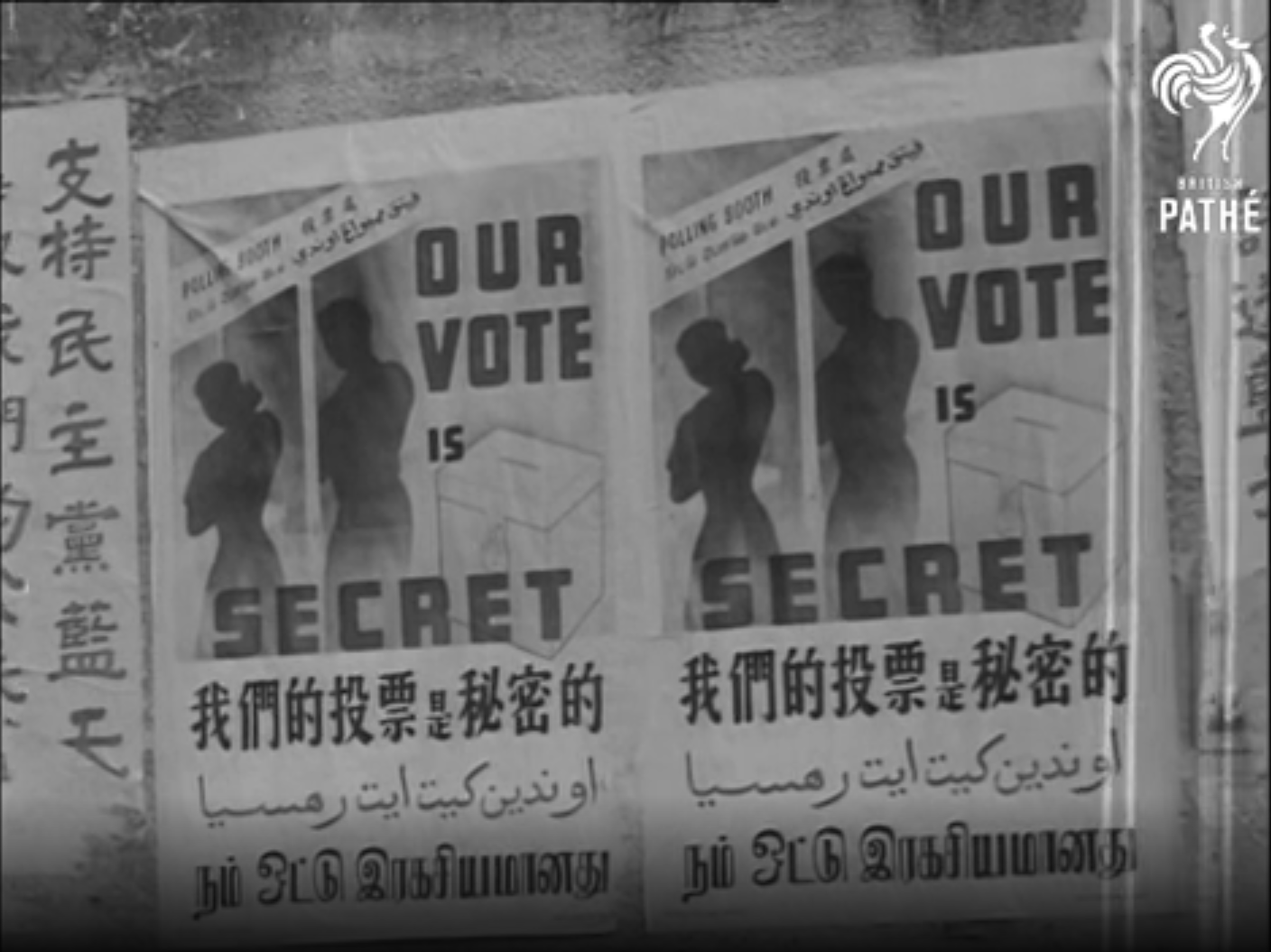
For the loser now will be later to win
Singapore has never yet had an election quite as lively and as full of ideas as in 1955. Historian P.J. Thum has rather controversially called the 1955 elections our "only free and fair election".
At any rate, the British did not overtly influence or intervene in the elections of 1955. Without coercion, the election was won and lost on the power of ideas. Politicians fought to win voters with their visions of a future Singapore, not with "knuckle-dusters" at "cul de sacs."
People living in 1955, however, would probably not have expected that this brief flourishing of political diversity to be an aberration. With greater political power, the stakes grew. Politics became more cutthroat; more violent.
In response, more machivellian and realist politicians like Lee Kuan Yew took the politicla initiative. And with their rise, alternative visions of what Singapore could be slowly faded away from public memory.
To explore the results in greater detail, click here.